
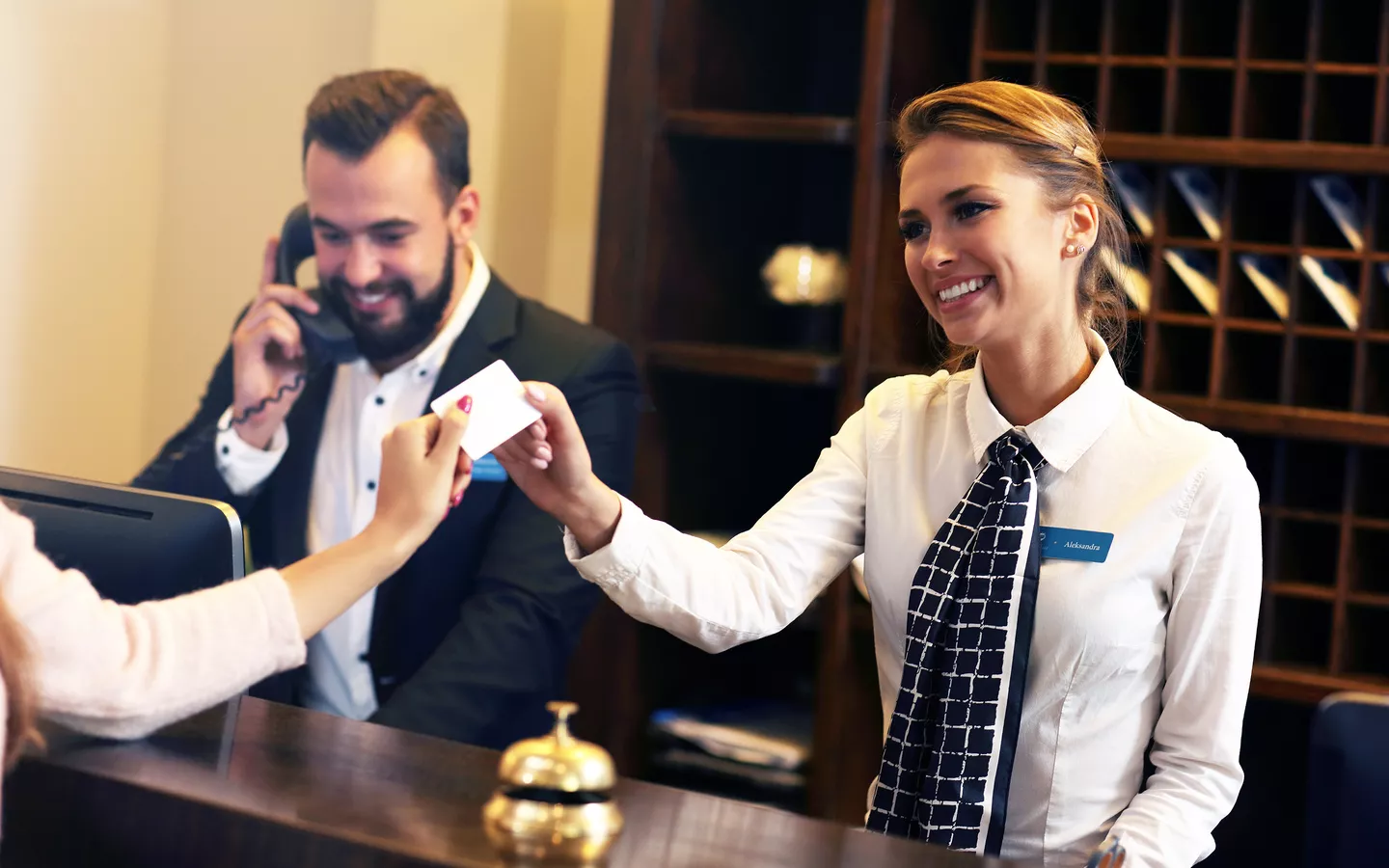
The first moments a guest steps through the hotel’s door form the foundation of their entire experience. In these first seconds, noticing how important greeting sentences are creates a fundamental change in service quality. The seemingly small difference between a “Welcome” and a “Hello, it’s so nice to see you” actually completely shapes the image that forms in the guest’s mind about your brand.
The consultations I’ve had with thousands of professionals working in the tourism sector and the experiences I’ve observed in hotel operations taught me this: The shared characteristic of hotels with high customer satisfaction is not their technical infrastructure but the human factor. Especially the language used by front-office, reception, and greeting staff determines the comfort and trust the guest will feel throughout their entire stay.
Why Does Brand Perception Start to Take Shape at the Moment of Greeting?
The human brain’s process of forming a first impression takes only a few milliseconds. When a guest enters the hotel, while evaluating the physical environment with their senses, they also perceive your tone of voice, word choices, and speaking speed through their hearing. This cognitive process happens entirely subconsciously, and answers are sought to the guest’s questions “Does this hotel value me? Should I feel safe? Will I get quality service?”
Greeting sentences come in exactly at this point. A standard, robotic greeting (“Welcome, do you have a reservation?”) makes the guest feel like a number starting a process. Yet a personalized, warm greeting (“Hello, what’s your name? Yes, I see your reservation, it’ll be a wonderful weekend”) makes the guest special and makes your brand worth remembering.
Building an Emotional Bond with Word Choice
A mistake I encounter very often is greeting staff using very formal language. Sentences like “Greetings, sir, we’ll do the guest registration” bring to mind a hospital. Yet hotels have started to move toward home architecture. In a home environment, no one talks like this.
The basic principle of effective greeting sentences is keeping sincerity and professionalism in balance. Saying “It’s so good to have you” instead of “I’m very happy that we’ve greeted,” and saying “We’ve prepared our nicest upper-floor room for you” instead of “The upper-floor room isn’t available” makes a difference. This is not just wordplay; the synaptic connections that form in the guest’s brain are completely different, and your brand is perceived as “human-centered.”
One of the important points is using the guest’s name in your greeting sentences. After learning the guest’s name, including it in your conversation conveys the message “You matter to this hotel.” The expression “Ms. Ayşe, I want to give you the best help” reveals, compared to the sentence “Can I help you?”, how cold and distant the latter is.
How Greeting Sentences Reflect on Operational Success
On this topic, many hotel managers ask me this question: “These are aesthetic things; what’s the reality of the business?” The answer is very concrete: Hotels with low greeting quality have high guest complaints, low return rates, and negative online evaluations. Conversely, at hotels that provide a warm, personal, and attentive environment from the moment of greeting, guests overlook even small problems.
The reason for this is a psychological mechanism: If the guest develops a positive emotion toward the hotel and its employees at the initial stage, this emotion creates a halo effect. Small mistakes that may be made later stay in the shadow of this positive perception. But if the greeting starts negatively, every small problem grows and expands in the guest’s mind.
Practical Application: Designing Greeting Sentences
Now let’s go beyond theory and talk about practical strategies that can be applied at the hotel. Every hotel’s character, location, and target audience are different. A luxury hotel and a boutique hotel, a family-friendly facility and a hotel catering to businesspeople, need different greeting sentences.
For example, a receptionist working at a beach-tourism hotel can start with the theme of the summer months, a holiday atmosphere, and relaxation: “Welcome! You’ve come here to fully feel the sea, the sun, and relaxation, and we’re here to make this experience the most perfect it can be.” On the other hand, at a hotel where business-purpose stays are made in the city center, efficiency and professionalism should come to the fore: “Bienvenido! We’ll offer a comfortable working environment together with quality rest.”
You can develop your own greeting sentences by following three basic steps. First, define your brand’s personality. What kind of hotel do you want to be? Luxury and formal, sincere and personal, energetic and youth-focused? Second, determine the guest profile. Which age group, for what kinds of purposes are they coming? Third, combine these two factors and write authentic greeting sentences. Avoid using templates; sentences that reflect the local dialect, seasonal references, and the current situation are more impactful.
Another practical application is doing team training on your greeting sentences. It’s important that every employee feels ownership of these sentences, carrying a sense of ownership. Rather than a “You have to say this” approach, giving training in the form of “Why are these sentences written this way, what feeling do we want to give?” means employees turn your sentences into something living, into belief.
Sincerity in the Digital Age: From Online Reservation Communication to Physical Greeting
Today, the guest journey no longer begins at the hotel door. Often, it begins in the online reservation system or with the hotel’s social media messages. Your first greeting sentence can actually come in an email confirmation message or on WhatsApp. For this reason, ensuring a consistent greeting tone across all communication channels preserves your brand’s integrity.
When the guest comes to the hotel door, they expect the continuation of these preliminary stages. If they received a warm, personal greeting in their email, they’ll want to see the same tone in the physical greeting too. This consistency signals that your brand is reliable.
How Are Greeting Sentences Evolving at Contemporary Hotels?
Technology is changing the greeting experience too. At some hotels, check-in is done through a kiosk or mobile app. In this case, there may be no physical greeting, but the greeting sentences on the digital interface serve a similar function. There’s a big difference between “Welcome, your room key is ready” and “We were waiting for you! Your room key is ready, and if you have a question we’re reachable here 24/7.”
AI and chatbot applications have entered the greeting process too. Here the most critical point is that automation doesn’t lose the human touch. A bot can give correct information but may not be able to create a warm environment. Successful hotels create a combination of technology and human: the chatbot gives fast answers to basic questions while directing complex matters to a human agent, and in this handoff, uses warm language.
Conclusion: Small Sentences, Big Effects
The power of greeting sentences lies not in their size but in their honesty. The guest is very good at understanding artificial warmth. If you say your greeting sentences in a lifeless, mechanical way, the guest feels it. But if you truly want to make the guest’s stay meaningful, comfortable, and enjoyable, as a reflex of this intention, every word chosen, every intonation, automatically becomes right.
At Okay Supports, the most notable change we see at the hotels we provide consulting services to occurs in the greeting and front-office area. When we teach teams not just sentences but the guest-centered mindset behind these sentences, everything changes. When guest satisfaction increases, employee morale rises; when the customer return rate increases, hotel revenue increases; when online scores improve, new guests are attracted.
I invite the hotel managers, human resources experts, and reception staff reading this article to sit with this question: “What did the person greeting guests at my hotel today say? What did the guest feel?” If you’re curious about this, it means the time has come to make a change in this direction. The start is very simple: Today, review your greeting sentences, write new sentences suited to your brand’s personality, and explain to your team why you’re making such a change. Then, apply them patiently, lovingly, and consistently. You won’t need to wait long to see the results.