
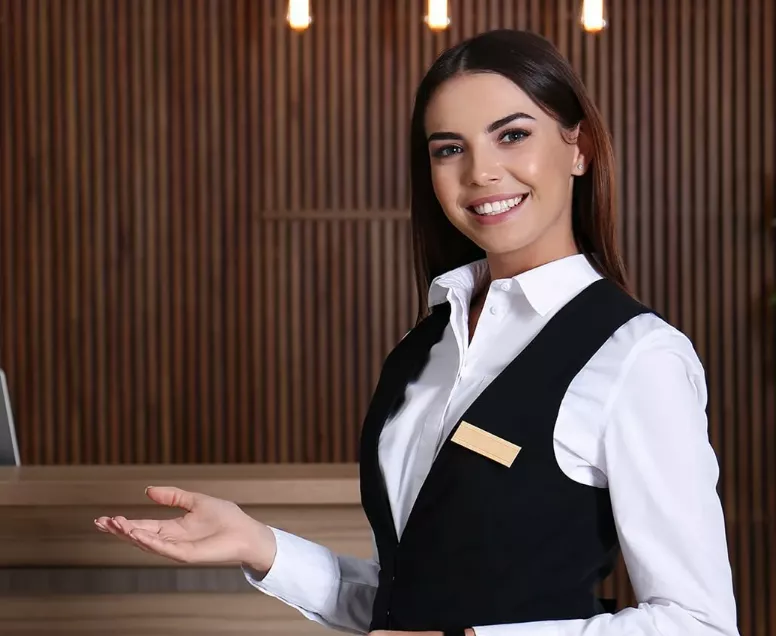
Think of a small scene playing out in a hotel lobby: a tired-looking employee at reception carries out the check-in of an arriving guest with slumped shoulders and averted eyes. However warmly the guest is greeted, that negativity in the body language overshadows the whole experience. This is a fact that’s often overlooked but extremely critical in the hospitality sector. Body language is not a complement to verbal communication; it’s sometimes a carrier of a stronger message than it.
Every moment guests spend at the hotel is shaped by employees’ physical movements, postures, facial expressions, and even their silent moments. Research shows that people perceive 55% of communication through body language, 38% through tone of voice, and only 7% through words. This means that as important as, or even more important than, what a hotel employee says is how they say it.
Body Language and First Impression: The Critical First Seconds
The first moments of guests arriving at the hotel are the moments when almost everything is determined. A guest entering the lobby, upon seeing the staff greeting them at reception or the door, immediately starts to read their body language. If the person greeting them displays proper posture, makes eye contact, and shows a natural smile, at that moment the guest gets the message “I’ll be taken care of well here.” On the flip side, an employee whose body language is closed or negative greets the guest with a negative impression right away, however warm the words they use.
In a project I joined in an observer role with a manager, the hotel management was hearing that there was an increase in guest complaints. Yet it was high season at the hotel, and services were at a normal level. The problem turned out to be simple but deep-rooted: the staff team was working under stress and showing this with their bodies. Fast steps, tense facial expressions, a lack of eye contact… All of this created a “feeling of discomfort” in guests. After training that developed posture and expressions, the same guest feedback turned strikingly in a positive direction.
The Power of Eye Contact and the Message of Attention
One of the most powerful elements of body language is undoubtedly eye contact. A hotel staff member giving their attention when looking at a guest is not just a professional requirement; it’s also a message telling them “you matter.” From the assistant chef starting out in tour guiding to the staff providing concierge services, making eye contact makes the guest feel valued.
Along with this, eye contact has its own considerations. In Turkish culture, excessively long eye contact can sometimes be uncomfortable. The right approach is to make a sincere eye contact that shifts every 3–4 seconds; looking at the guest while they speak, then a glance that briefly moves away but returns. This shows you’re actively listening and focused on the guest’s requests. Especially when front-office staff talk with a guest dealing with a problematic issue, this kind of eye contact starts the matter on the solution side.
Posture, Movement, and the Perception of Confidence
The posture of an employee walking in the hotel lobby or corridors sends a message about the professionalism level of the whole hotel. Slumped shoulders, walking with the head down, or a static posture become a negative symbol for the whole organization. On the contrary, upright posture and calm, deliberate steps reflect the confidence of both that person and the whole hotel team.
It’s important to be aware of this: guests aren’t interested only in the service offered to them; they also sense the dynamics they see throughout the hotel. A housekeeping staff member walking happily and upright, a receptionist displaying a comfortable posture while talking on the phone, a gardener or technical staff member showing a cheerful expression while working… all of these are connected details that complement the whole.
Expressions and the Contagion of Emotions
The human brain is programmed to automatically reflect the emotions it sees before it. Psychology explains this with the theory of “mirror neurons.” In practical terms, a guest who sees a cheerful and sincere smile, even unconsciously, feels that cheer and sincerity. Conversely, an artificial or never-smiling face creates unease in the guest.
When talking about written protocols for hotel receptionists, sentences like “Greet every guest with a smile” are frequently seen. But there’s an important point here: the smile must be sincere. An artificial smile can actually give twice the discomfort that not smiling at all gives. For this reason, when trainings delve into not just the question “what will you do” but the depth of the question “why will you do it,” employees should be enabled to truly feel and express these emotions. Stress management, motivation, and job satisfaction are actually critical factors that also shape body language.
Managing Distance and the Comfort Zone
An overlooked but important topic when it comes to body language is personal distance. Although it varies by culture, in the Turkish context a social distance of about 45–90 centimeters is considered normal. A hotel staff member standing too close while talking with a guest (especially for elderly or slightly anxious guests) can be uncomfortable. Conversely, standing too far can also create a businesslike or distant air.
To give a practical example, a staff member providing concierge service showing that they’re listening—at an appropriate distance, in a slightly leaning posture, and with yes/no head movements—while listening to whatever the guest wants makes the guest feel much more comfortable. This is a body-language combination that seems simple but creates an interpersonal connection that makes people not want to leave the hotel.
The Importance of Body Language in Crisis Situations
Hospitality doesn’t always go smoothly. Reservation errors, room problems, wrong services… the emotional state of guests who encounter such problems is already negative. This is exactly when the body language of the staff solving the problem becomes extremely critical. If a staff member takes a retreating or defensive posture while talking with a problem-facing guest, the problem multiplies. But a staff member displaying a calm, open, and problem-focused body language can ease a difficult situation and even win the guest over.
I remember a scenario where a hotel manager was at their staff member’s side in a conflictual situation. When the staff member took a closed posture against the guest’s complaint, the manager stepped in, talked with the guest with an open and upright posture, and closed their eyes and listened to the details of the problem. Meanwhile, the staff member gradually began to open up too. In the end, the manager’s body language gave the message “this situation can be solved” to the staff member too, and a problem-solving environment formed.
Team Dynamics and Internal Body Language
As important as the external guest experience, internal team dynamics matter too. A positive and open body-language communication between the front office and housekeeping, between management and operational staff, spreads a positive energy throughout the hotel. Conversely, a tense, closed, or negative internal body language leaks to guests too.
At well-functioning hotels, when staff greet one another, their facial expressions and looks are positive. When it’s observed that the head doesn’t display a comfortable and equal posture while talking with a staff member in the corridor, this hierarchical closedness reaches all the way down to the lowest staff member and affects the guest experience. Quite the opposite; when a warm and open internal body-language culture is created, every employee appears more confident and cheerful in front of the guest.
Training Body Language: Creating Awareness
So, is it possible to train body language? Absolutely. But what matters here is not just giving directives like “stand up straight” or “smile” but ensuring staff are aware of why this is so important. Effective trainings are done with video feedback, role-play exercises, and self-awareness work.
The training process shows staff how they read their own body language, what kind of message they give the guest, and its mutual effect. For example, a receptionist seeing how they look in front of a guest through the replaying of a video often leads to a revolutionary change in them. Questions like “Oh, do I really look this closed?” come at the start of behavior change.
Conclusion: The Voice of Silent Communication
Hospitality is a business of fine details. What ensures guest satisfaction is not just high-quality beds, good cleaning, or delicious food. Equally, and often even more, the emotional experience the staff provides matters. Body language is the quietest but most powerful language of this emotional experience.
The whole hotel team being aware of its own body language and using it deliberately for guest satisfaction will continue to be a real differentiator in the competitive hospitality world. From beginning to end, the feeling your guest should feel should be “I’m considered here, I’m valued, and welcome.” The biggest part of this message is conveyed without anyone saying anything, just through body language.
If you’re thinking of building a deeper, more effective body-language culture at your hotels, your staff training programs should do a lot on this topic. Because in the final analysis, guests remember not the words but the body language they felt, and this is what shapes your business’s reputation.